The Complete Maldives
Honeymoon Guide 2026
Which atoll, which resort, how much it actually costs — and what nobody tells you before you book.
The Maldives is one of the few places in the world that consistently exceeds expectations. The photographs do not lie — it genuinely looks that way. The water is that colour. The bungalow does float that close to the surface. The silence at 5 AM, when the lagoon is perfectly flat and the sky turns pink, is that complete. But the Maldives can also be deeply expensive, badly planned, and quietly disappointing if you book the wrong resort, arrive at the wrong time, or spend your budget on the wrong things. This guide fixes that.
We have broken down exactly how to choose your resort, which atolls offer what kind of experience, what a realistic budget looks like at three different price points, and what you should actually spend your money on once you arrive. No filler. Just the decisions that determine whether your honeymoon is unforgettable or merely fine.
Before You Book Anything, Read This
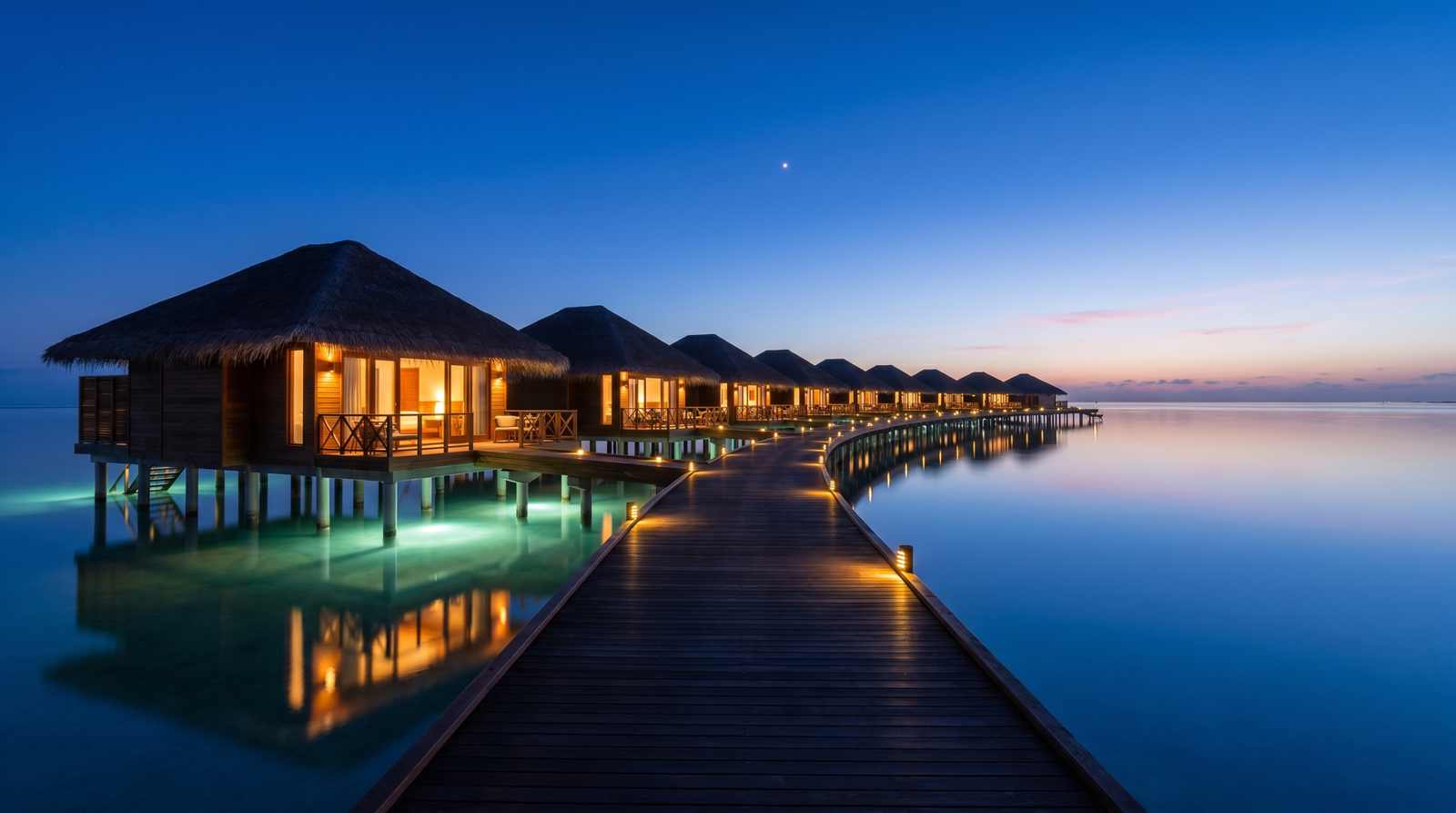
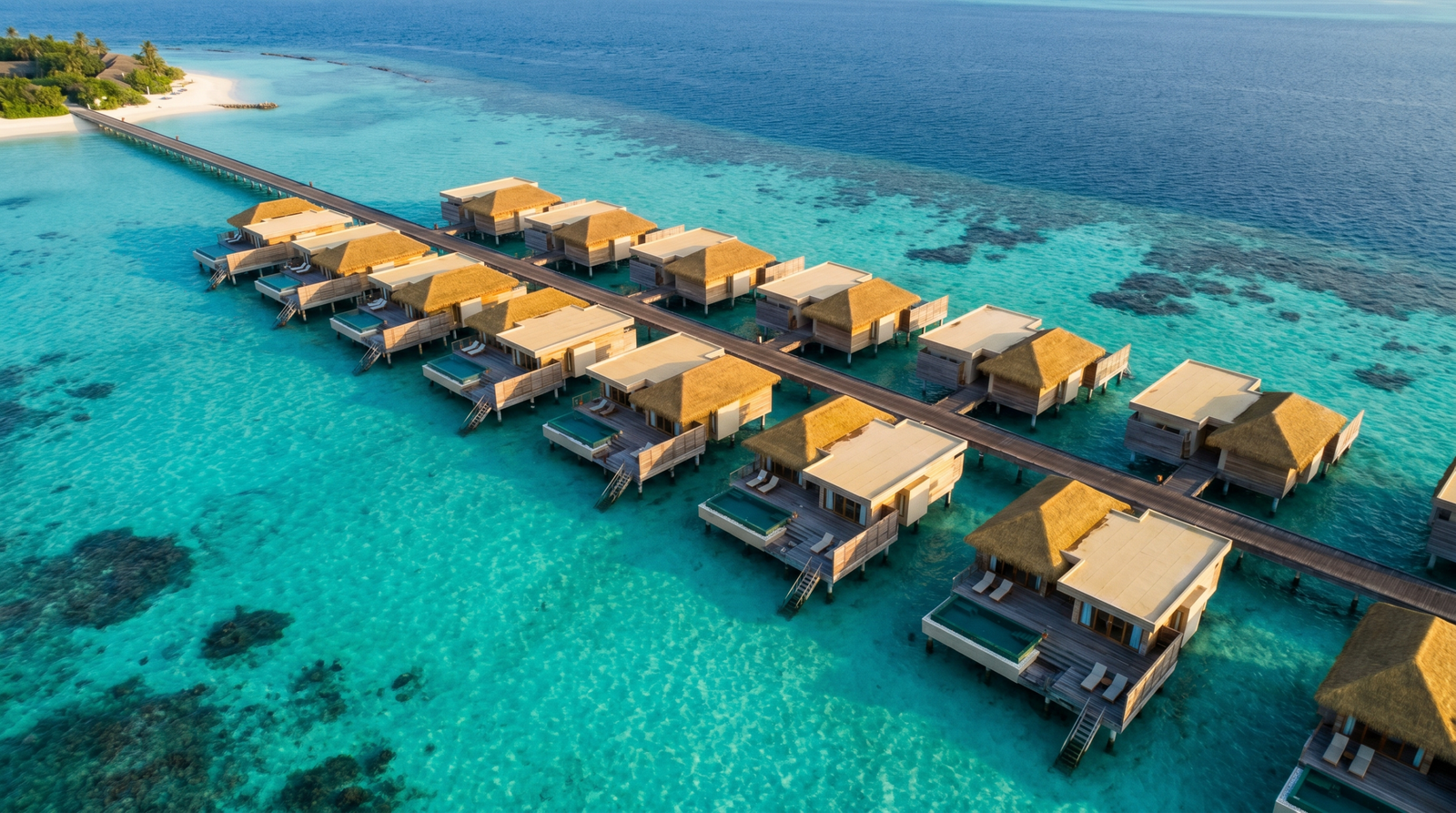
The Maldives is an archipelago of 1,200 islands spread across the Indian Ocean, but only about 200 are inhabited and roughly 160 are resort islands — meaning a single resort owns the entire island. This one-island, one-resort model is the reason the Maldives feels so private: when you are at your resort, there are no day-trippers, no local town to walk into, no external restaurants to escape to. You and the other guests have the island to yourselves.
This is both the appeal and the limitation. It creates unmatched exclusivity, but it also means you eat all your meals at the resort, do all your activities through the resort, and spend your entire stay within the same stretch of sand and water. Understanding this upfront lets you budget correctly and choose a resort that genuinely fits how you want to spend your days.
The Atoll System: Where You Stay Changes Everything
North Malé Atoll is the most popular and most accessible — resorts here are 20 to 45 minutes from the airport by speedboat, with no seaplane required. Names like Baros, One&Only Reethi Rah, Conrad Maldives, and Soneva Jani sit here. The water is clear, the reefs are excellent, and the speedboat access keeps transfer costs low. The best starting point for first-time visitors who want the full Maldives experience without complicated logistics.
South Malé Atoll is where Anantara Veli, Centara Grand, and Coco Bodu Hithi sit. A little further south of the airport, still speedboat-accessible, and generally less crowded than the North Malé cluster. The best concentration of mid-range resort value anywhere on the archipelago.
Baa Atoll is a UNESCO Biosphere Reserve and home to Hanifaru Bay — the world's best spot to snorkel with manta rays, with aggregations of 200 or more mantas between July and November. Getting here requires a seaplane from Malé (25 to 35 minutes, $400–600 per couple return). Worth it specifically for the manta ray experience and for the sense of remoteness that the northern atolls deliver.
Ari Atoll is famous for whale sharks — the largest fish in the ocean, resident year-round in the South Ari Marine Protected Area. Resorts include W Maldives, Constance Moofushi, and Lily Beach. Seaplane from Malé, 30 to 40 minutes. The combination of whale sharks and excellent house reefs makes this the best atoll for couples who want serious marine life encounters alongside the beach experience.
Lhaviyani and Raa Atolls are further north — longer seaplanes, higher transfer costs, but uncrowded reefs and a genuine sense of remoteness that the more accessible atolls cannot match. Kuredu Island Resort and Komandoo Island Resort are standout options at prices significantly below the flagship luxury properties. If budget is a meaningful constraint but you still want the overwater bungalow experience, these atolls reward careful research.
The seaplane question: Seaplanes only fly in daylight — roughly 6 AM to 6 PM. If your international flight lands in Malé at night, which most long-haul flights from Europe, the US, and Asia do, you will spend a night in Malé before flying to your resort the following morning. Budget for this night. A room at the Waldorf Astoria Ithaafushi or Crossroads Malé runs $150–400 and is perfectly comfortable. Many resorts do not disclose this clearly during booking — always check your transfer type and arrival time before confirming.
The Honest Seasonal Guide
The Maldives has two seasons: the dry northeast monsoon (November to April) and the wet southwest monsoon (May to October). Wet season is not a disaster — it means occasional afternoon storms, slightly higher humidity, and remarkably productive marine life. Many couples honeymoon in May, June, and September and have brilliant trips. The honest breakdown:
December to April is peak season. Skies are consistently clear, water visibility for diving and snorkelling reaches 30-plus metres, and the Maldives looks exactly like every photograph you have seen. Prices run 30–50% higher than wet season rates. December through February is the most sought-after window — book at least three to four months ahead for your preferred resort and room type.
May and June are the transition months — some days are perfect, some have rain. Prices drop 20–30% across most resorts. If your priority is value and you have flexibility around occasional beach days, this window is consistently underrated. The marine life is extraordinary during this period; manta rays begin arriving in Baa Atoll from July and whale sharks are present year-round in Ari Atoll regardless of season.
July to September is deep wet season, but also the peak window for manta rays in Baa Atoll. Resort prices are at their lowest. Divers and snorkellers often prefer the marine activity of wet season over the calmer but emptier dry season waters. Rain typically comes in short intense bursts rather than all-day grey — most couples find it more manageable than the "wet season" label suggests.
October transitions back toward dry season — increasingly good weather, still lower prices, and excellent diving conditions as the seasonal fish aggregations remain active. One of the most underrated times to visit for couples who want value without sacrificing experience.
Resort Recommendations by Budget
The Maldives resort market spans from $300 to over $10,000 per night. Here is how the landscape breaks down across three meaningful price tiers — what you actually get at each level and whether it justifies the cost.
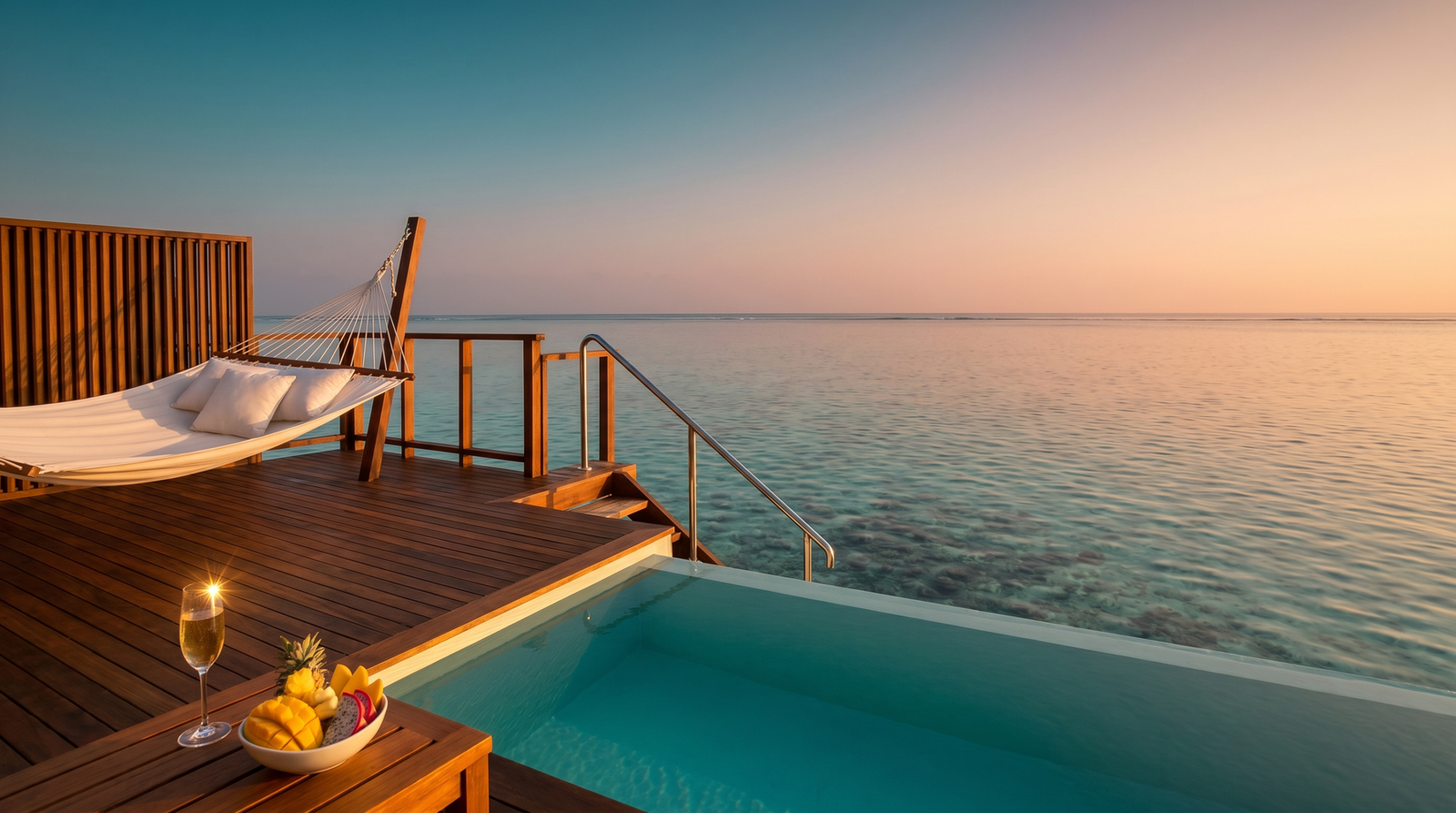
The private deck at an overwater villa. You will spend more time here than anywhere else on the island — and that is entirely the point.
Luxury — $800–2,000 per night
The original overwater villa resort and still the benchmark against which others are measured. Home to Ithaa — the world's first all-glass undersea restaurant, where you dine below the ocean surface surrounded by coral and reef life. Two islands connected by a bridge, one dedicated to water villas and one to beach villas. The overwater bungalows here defined what the category means globally and have not been surpassed.
Consistently rated among the most romantic resorts in the Indian Ocean — and consistently wins that category in international travel awards. Small and intentionally intimate at 75 villas, with service that knows your name by the second morning. The house reef is exceptional for snorkelling directly from the water villa steps. The Lighthouse restaurant serves fine dining on a raised terrace directly over the lagoon.
Mid-Range — $350–700 per night
The strongest mid-range option in the Maldives for couples who want the overwater experience without the flagship resort price tag. Excellent all-inclusive packages (genuinely rare at this atoll), a proper dive centre, and well-appointed water villas. The South Ari Marine Protected Area puts whale shark snorkelling within easy reach directly from the resort — a significant advantage over most comparable properties.
Value — $180–350 per night
The Maldives is not exclusively for $1,000-a-night budgets. Kuredu is a large, lively resort with excellent dive facilities, a proper beach, multiple restaurants, and lagoon bungalows that genuinely deliver the Maldivian overwater experience at a fraction of the flagship prices. More social and less secluded than the luxury island resorts, but the best real Maldives experience available per dollar spent at the value end of the market.
Experiences Worth the Money — and What to Skip
Most Maldives activities are significantly overpriced when booked through the resort. Here is an honest assessment of what genuinely justifies its cost and what you can skip without missing anything meaningful.
Free, requires zero planning, and consistently the most underrated experience the Maldives offers. Most resorts have a reef directly accessible from the beach or from the steps of the water villas. Go at 6 to 7 AM before the wind picks up and the day-trip boats arrive. The water is at its flattest, the light through the coral is extraordinary, and you will almost certainly have the reef to yourselves. No guide, no booking, no cost — just fins, a mask, and the sense to not touch anything.
If you are staying anywhere near South Ari Atoll, this is the single best activity in the Maldives. Whale sharks are gentle, filter-feeding, and can reach 12 metres in length. The South Ari Marine Protected Area has the highest resident whale shark density in the world — they are present year-round, not seasonally. Swimming alongside one in clear, calm water with nothing else around you is one of the defining nature experiences available anywhere on earth.
Hanifaru Bay aggregates hundreds of manta rays in a small, regulated area during the plankton bloom — aggregations of 200-plus mantas have been documented here, making it the single greatest snorkelling spectacle on earth. Entry to the bay is strictly controlled; only licensed guides can take visitors in, and daily numbers are capped to protect the ecosystem. Only accessible from Baa Atoll resorts or as a boat day trip from neighbouring atolls.
Most resorts in North and South Malé Atoll offer spinner dolphin cruises at sunset — the local pods are resident and reliably encountered. The pods typically number 50 to 200 individuals, surfing the bow wake of the dhoni (the traditional Maldivian wooden boat) as the sun descends. Watching dolphins leap at eye level from open water, with no land visible in any direction and the sky going orange behind them, is a completely different experience from watching them from a beach.
Most resorts can arrange a private transfer to a nearby uninhabited sandbank — a strip of white sand 30 to 60 metres long surrounded by nothing but the Indian Ocean. Champagne, cold towels, fresh fruit, and complete isolation. You are the only people on the sandbank. There is no mobile signal. There is nowhere to be and nothing to do except be there. This is the experience the Maldives was built for, and no resort photograph captures what it actually feels like to stand on it.
If neither of you has ever dived, a resort-based Discover Scuba session takes you to 5 metres under close supervision with no certification required. The Maldives is consistently ranked among the top five dive destinations on earth — experiencing even a fraction of it underwater fundamentally changes how you see the surface above. Nurse sharks sleeping under coral, Napoleon wrasse the size of coffee tables, and reef fish in colours that simply do not exist above the waterline.
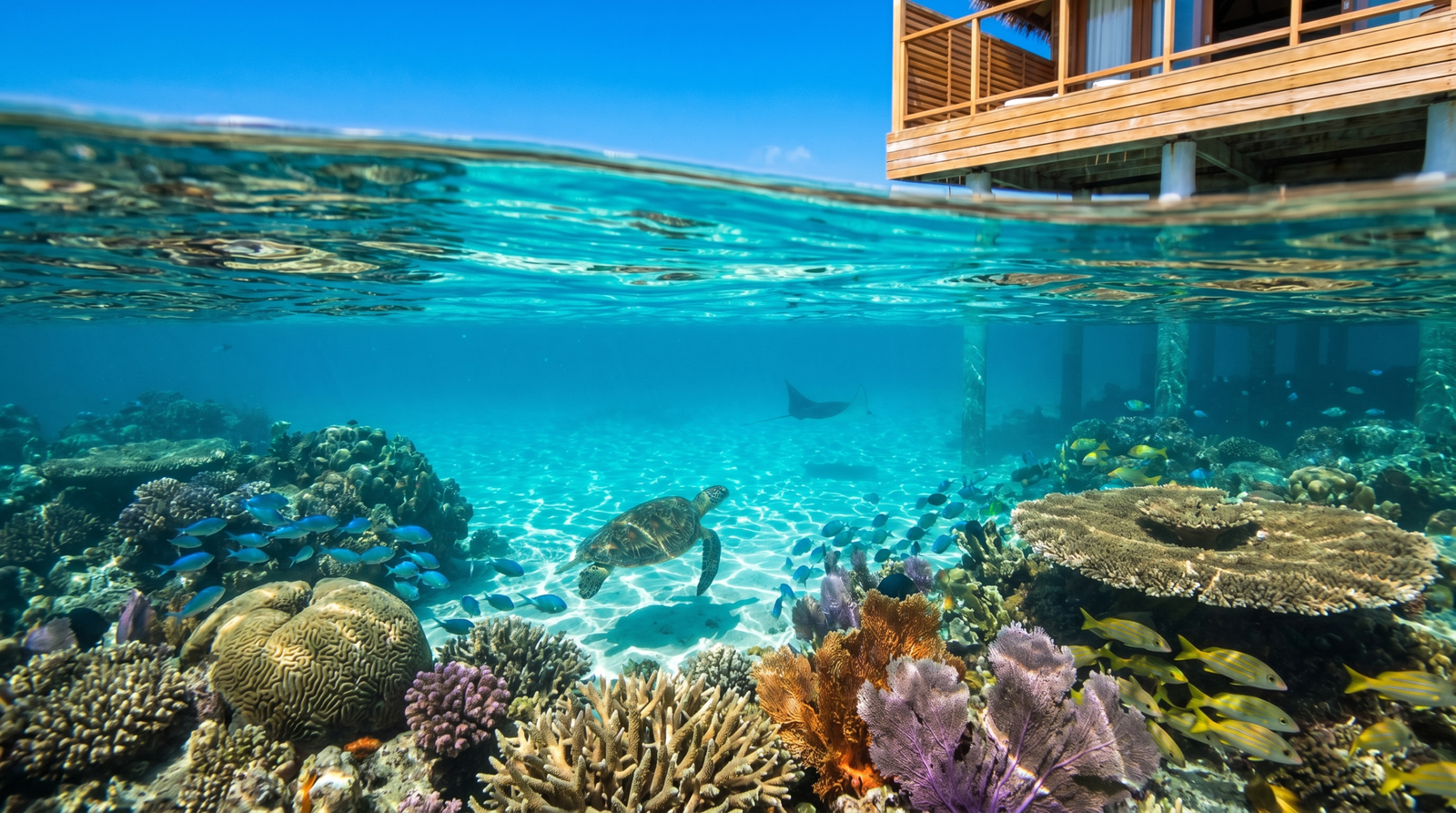
The house reef, accessible directly from your villa steps. Free, bookable any morning, and consistently the experience couples remember most.
Food in the Maldives: What to Expect
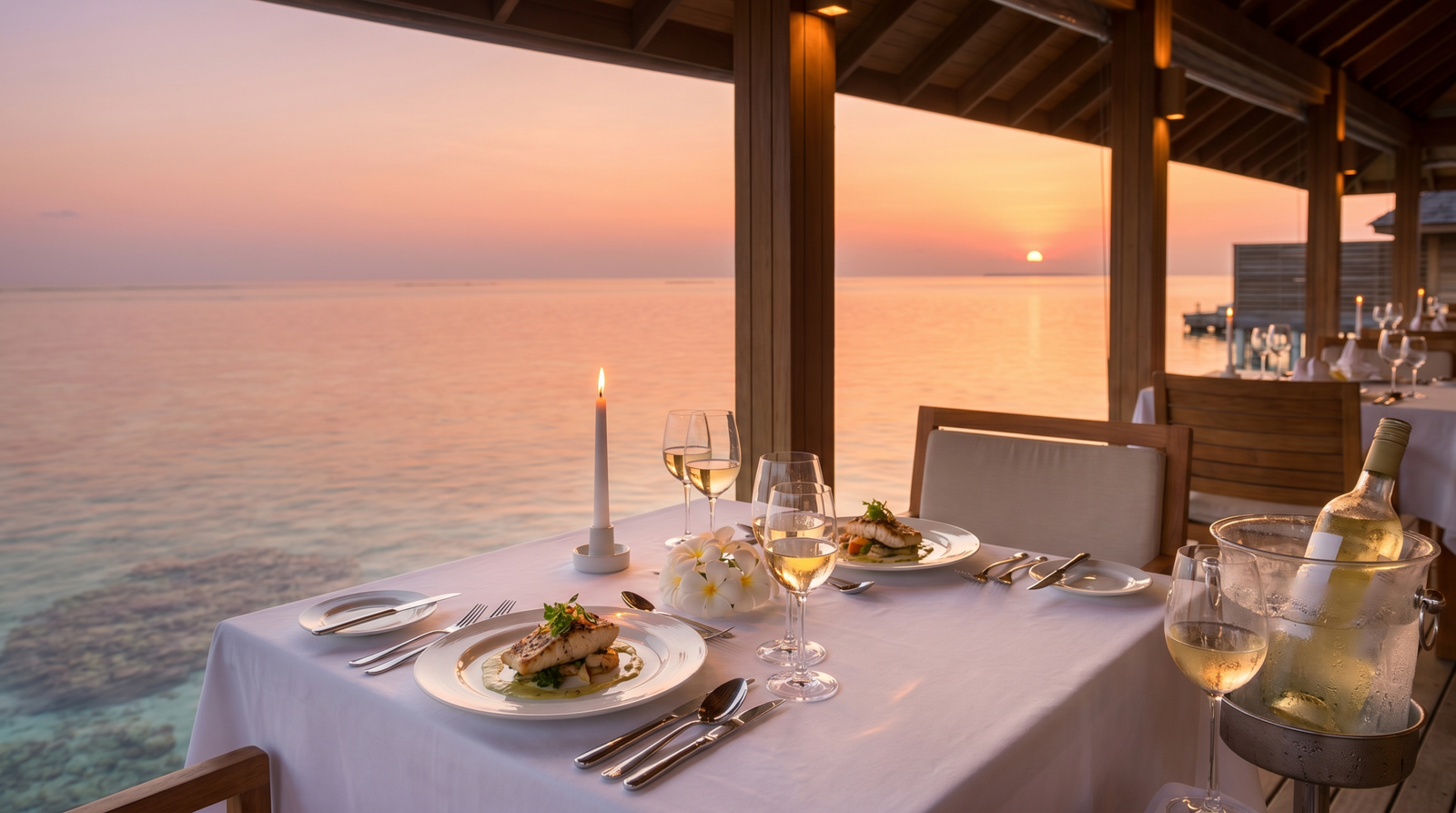
Dinner over the lagoon at a luxury resort. The seafood arrives from the boats that morning — the freshness is not a marketing claim.
Maldivian cuisine is not the primary reason you are here. The country's indigenous food — mas huni (shredded smoked tuna with coconut and chilli), garudhiya (tuna broth), and roshi (flatbread) — is genuinely good but uncomplicated. Resort restaurants serve international cuisine of variable quality at predictably high prices. Here is how to navigate food costs, which are the single largest surprise for first-time visitors:
What a Maldives Honeymoon Actually Costs
| Category | Value Trip | Mid-Range Trip | Luxury Trip |
|---|---|---|---|
| Resort — 7 nights | Kuredu / Adaaran $180–250/night |
Centara / Coco Bodu Hithi $400–600/night |
Conrad / Baros $900–1,500/night |
| Flights (return, economy) | $600–900/couple | $600–900/couple | $2,000–5,000 (business class) |
| Seaplane transfers | $0 (speedboat atoll) | $0–400 | $400–800 |
| Food & drinks | All-inclusive included | $100–200/day | $250–450/day |
| Activities | $200–400 total | $400–800 total | $600–1,500 total |
| Total estimate | $3,500–5,500 | $7,000–12,000 | $18,000–35,000 |
These are honest estimates based on real 2026 bookings, not aspirational marketing figures. The single biggest variable after resort choice is season — the same resort can cost 40 to 60% less in May through October versus December through March. If your budget has meaningful limits, booking shoulder season and choosing a mid-tier overwater bungalow resort in Lhaviyani or South Malé delivers a genuinely extraordinary honeymoon at a fraction of the peak season luxury price.
Everything Else You Need to Know
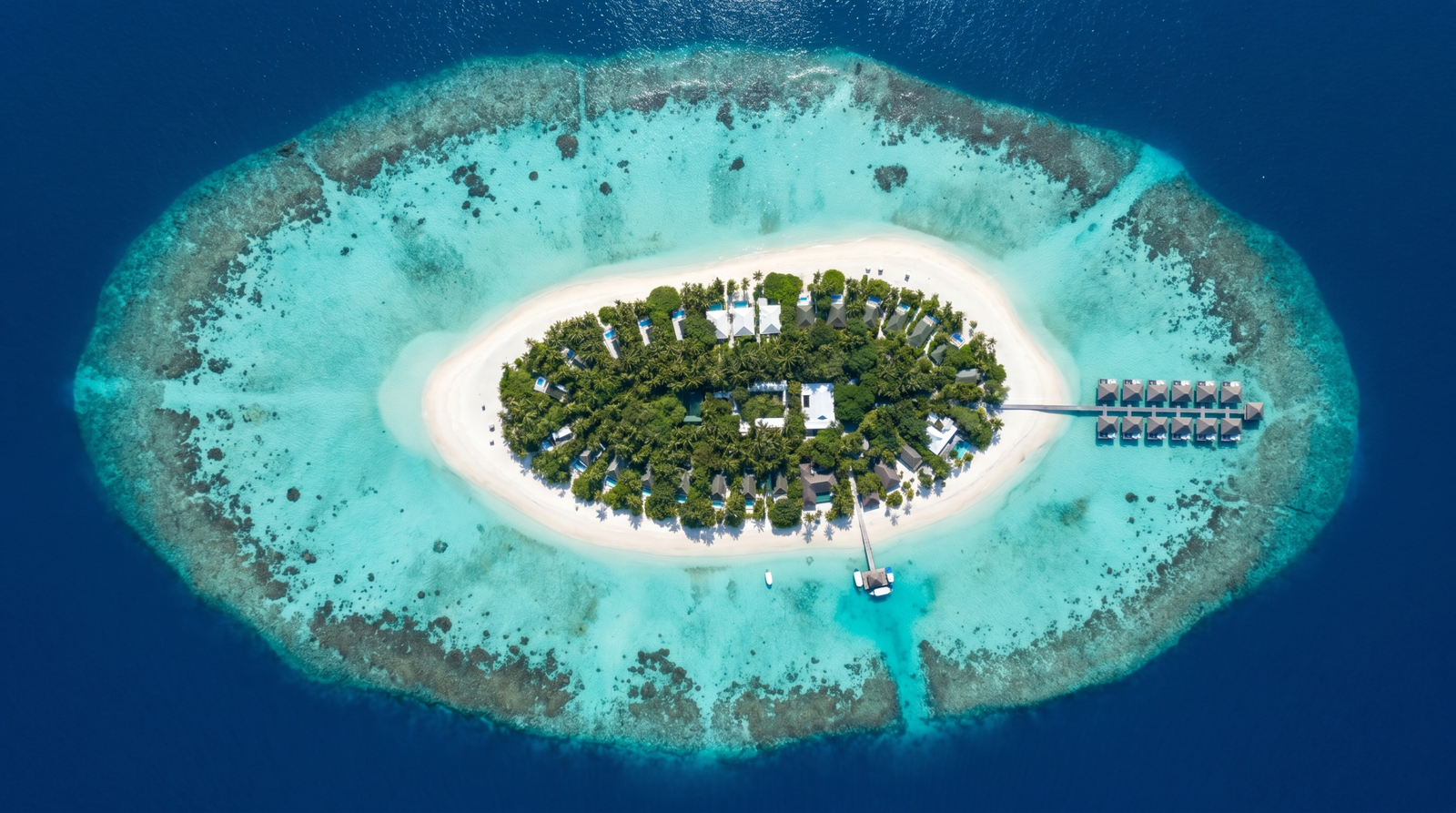
The one-island, one-resort model from above. When you are here, the entire island belongs to you and your fellow guests.
Getting There
Velana International Airport (MLE) in Malé is the gateway to the Maldives, served by Emirates, Qatar Airways, Singapore Airlines, Turkish Airlines, and several regional carriers. Most visitors connect through Dubai, Doha, Singapore, or Colombo. Flight time from London is approximately 10 to 11 hours via the Gulf hubs. From Singapore, around 4 hours direct. Book flights and resort transfers as a package where possible — many resorts offer preferred rates on seaplane connections when booked together.
Visa
Most nationalities receive a free 30-day visa on arrival in the Maldives — no advance application required for passport holders from the EU, UK, US, Australia, and most other countries. You need a confirmed resort booking, a return ticket, and evidence of sufficient funds. Immigration is fast and well-organised; most couples clear it in under 20 minutes.
Currency & Money
The Maldivian Rufiyaa (MVR) is the official currency, but US dollars are accepted at face value at every resort and at the airport. All resort billing is in USD. Bring a mix of USD cash and a credit card — some smaller activities, local island visits, and souvenir purchases require cash. Inform your bank of travel dates before departure to prevent automated fraud blocks on foreign transactions.
Alcohol
The Maldives is a Muslim country — alcohol is not available on local inhabited islands. At resort islands, which operate under international licences, there are no restrictions whatsoever. Sundowners on your private deck, champagne at the sandbank, wine at dinner — all completely available and well-stocked at every resort tier.
Health & Packing
No vaccination requirements for most nationalities. Malaria is not present in the Maldives. The equatorial sun is intense — sunscreen is non-negotiable, and the lagoon reflects UV directly back upward. Biodegradable reef-safe sunscreen is mandatory at most resorts to protect the coral ecosystem — standard chemical sunscreens are banned on many islands and may be confiscated at check-in. Pack light linen clothing, swimwear, one smart outfit for any undersea or fine dining experiences, an underwater camera or GoPro, and any prescription medication you need. Resort pharmacies are expensive and have very limited stock.
Connectivity
Resort WiFi is included at every property and speed varies with the tier — excellent at luxury resorts, intermittent at some value properties. A Dhiraagu or Ooredoo SIM card bought at Malé airport ($10–15 for a basic data package) works throughout the Maldives if you need consistent coverage. Most couples find that the naturally limited connectivity is one of the most welcome aspects of the trip.